Showing posts with label bibliography. Show all posts

Wednesday, November 14, 2007

gothic fakes


Gothic is about the denial of depth and the insistence on the surface - on the mask rather than the face, the veil rather than what lies beneath, the disguise rather than what is disguised." (from Sedgwick)

"Gothic... possesses no original." Spooner, 32

The very notion of 'mock gothic' is... an oxymoron, because one cannot mock what is always already mocking itself. (35) (camp, and the misfits.)

(unchained melody: 9:23am)

"the legacies of the past and its burdens on the present

the radically provisional or divided nature of the self

the construction of peoples or individuals as monstrous or 'other'

the preoccupation with bodies that are modified, grotesque or diseased...

Gothic has become so pervasive precisely because it is so apposite to the representation of contemporary concerns...

we should perhaps be careful of assuming that the Gothic simply reflects social anxieties in a straightforward manner - as a genre deliberately intended to provoke horror and unease, it plays to audience expectations and therefor is rather too self-conscious to illuminate our most secret fears..."

"There is no 'original' Gothic; it is always already a revival of something else."

Catherine Spooner


- Gothic as 'the passionate overthrow of reason' coming from 5th century Goths' overthrow of Rome

- Gothic as a retrospective architectural term for medieval structures embellished with pointed arches, grotesque angles, gargoyles, stiff elongated figures and elaborate detail... ignoring the clean lines and proportional curves of Classical styles.

"[A Gothic text should comprise] a fearful sense of inheritance in time with a claustrophobic sense of enclosure in space, these two dimensions reinforcing one another to produce an impression of sickening descent into disintegration..."

Chris Baldick


(etymological/historical tensions between definitions: gothic as transcendent spiritualism or corporeal horror?)

:Gothic text: past as a site of terror, injustice that must be resolved, evil that must exorcised. 'the past chokes the present, prevents progress...'

:Gothic (Revival) architecture: the past is imbued and invested with nostalgia and idealism.

Perhaps it is only secure cultures that produce Gothic texts...

it is only a society that has stopped believing in ghosts that is able to turn them into the stuff of entertainment.

liminal inks


Written on the Body - ed. Jane Caplan

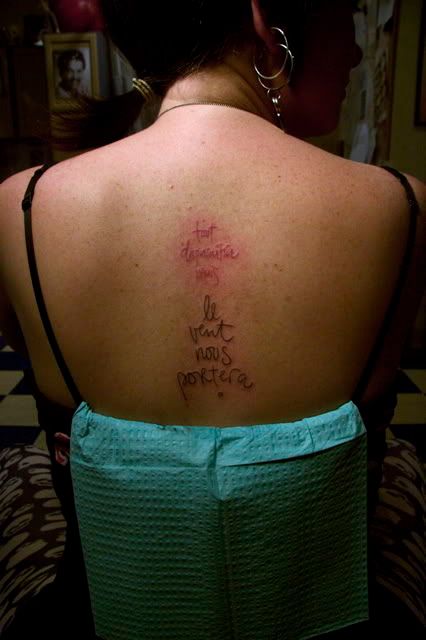
I've been getting all these new tattoos lately, and wanting more and more.

("is it the pain or the art?" dad asks.
"bit of both." and then the whole healing process - the crustacean ink, the itch.
)

the tattoo is "an indelible insertion that is both visible and out of reach... an exchange between interiority and exeriority, 'a paradoxical double skin...'" (xiii)

infidel(ities):

You shall not gash yourselves in mourning for the dead: you shall not tattoo yourselves." (Leviticus)

much in the first few chapters about the etymology of the tattoo - the (disputed?) relation between 'stigmata' and what we think: ink.

stigma.

brian summed up (a part of it) well : tattoos are so temporary. disregard all the warning speak of permanence. these drawings die with me (except for: see Roald Dahl: Skin). unlike the paintings (crap paintings) that go nowhere except for into corners, the boxes of photos, of letters and books and books and books of drawings. art on the body to do nothing with but burn when body burns.

Wednesday, October 31, 2007

responding to the community (in part)

Reading Six Feet Under (Kunstmuseum Bern), this from Thomas Macho's The Return of the Dead after the Modern Age:

"Death does not occur in time but in space... Spatial arrangements reflect the event that is death, an event that negates all social order and therefor the spaces within which the members of a society usually operate... complex rituals and ceremonies, measures designed to defend and protect, are enacted to counter such a risk. All death rituals are first and foremost an attempt to realign the injured social space..."


I like the idea of thinking of loss as spatial rather than temporal, and it seems to speak to Matthew's idea of death as social rupture.

As an utter and total narcissist myself it takes some stretching to get past the (very American indeed) feeling (exactly) that that absence is mine...

Monday, October 29, 2007

more books (and reading)

Phillippe Aries: Western Attitudes toward Death

Thomas Lynch: The Undertaking: Life Studies from the Dismal Trade

Catherine Spooner: Contemporary Gothic and Fashioning Gothic Bodies

Geoffrey Galt Harpham: On the Grotesque: Strategies of Contradiction in Art and Literature

Kunstmuseum Bern: Six Feet Under: Autopsy of our Relation to the Dead

(i went to the library)

I have a meeting with Terri on Wednesday to talk serious about this thesis. I feel no closer to what it is I want or need to/should do with it - do it for. I need to present timelines, deadlines, outlines and models. I am reading Mourning Sex and underlining often. But still my 'response,' my reading, is emotive and receptive rather than critical/theoretical.
Indeed, why do I separate these out, divide in binarisms?

Wednesday (halloween) is my day to present and receive on the text I just 'completed' for Beth Nugent's writing class. it's all narrative - and personal - narcissistic confessional - moving inwards and outwards, backwards and forwards, structured around dates of journals / comments / poemish stuff. hyper colloquial, and here.

My intention in presenting it to the class is to question the efficacy of personal narrative (relating to trauma + loss) and whether showing rather than speaking about the relationships between desire and death, and timing and memory and the breakdown of language, functions as a part of said text's reading (whether this is obvious - or rather, if the unstated is received as a part of the text's 'statement' as much as what is said.)

(including experimentations in form / image as part of 'text'. etc)

This is what I like to do. I wonder if it would be 'possible' (in a theses sense) to spend the rest of this semester creating and editing these personal narrative texts and then use the next to theorize or expound or analyze those as if I were critiquing (my own work) as an example of the concepts I do wish to explore 'academically' but feel unable to do properly at the moment.

Shit, I dunno. I wish I were doing an MFA instead. I wish I knew what to show Terri on Thursday. And I still need a third reader.

Sunday, October 7, 2007

to add to fresh bookmeat...

Peggy Phelan: Unmarked
she is awesome, I mean come on:

"Unmarked attempts to find a theory of value for that which is not "really" there, that which cannot be surveyed within the boundaries of the putative real. By locating a subject which cannot be reproduced within the ideaology of the visible, I am atrempting to revalue a belief in subjectivity and identity which is not visually representable. This is not the same thing as calling for greater visibility of the hitherto unseen."

Peggy Phelan: Mourning Sex

Ernst Van Alphen: Caught By History: Holocaust Effects in Contemporary Art (horrible title, an even worse cover. But an excellent book!)

John Dewey: Art as Experience

Walter Benjamin: Theses on the Philosophy of History (his concept of 'acedia' is pertinent to loss and representation)

Ed. David Eng and David Kazanjian: Loss

I also just received De Certeau's Practice of Everyday Life. His chapter "Making Do" is awesome, expecially when he talks about perspective vs. prospective vision.

The challenge is how to fit it all into one thesis...

Thursday, October 4, 2007